
Why the wisdom of grandparents, mentors, and elders still shapes the next generation of culture-makers.
Before Marcus Aurelius became one of Rome's most celebrated emperors, he was a grandson. In fact, the first person he honors in his Meditations is his grandfather Verus, whom he credits with teaching him good character and self-control:
"From my grandfather Verus I learned good morals and the government of my temper." — Meditations, Book I, George Long translation
He goes on to thank his mother for her generosity, his great-grandfather for investing in his education, and his teachers for cultivating discipline and intellectual humility. It is a striking beginning to one of history's most enduring works of philosophy. Before reflecting on how to live a good life, Marcus acknowledges the people who taught him what goodness looked like.
Centuries later, St. Augustine would offer a distinctly Christian perspective in his Confessions. His mother, Monica, prayed for him through years of intellectual questioning and spiritual wandering. In Book IX, Augustine recounts their final conversations at Ostia, where they contemplate the joys of eternal life together. Their relationship reveals something profound about the formation of character: the influence of one generation may take decades to bear fruit. Augustine would become one of Christianity's most influential theologians, but his spiritual autobiography remains inseparable from the faith and perseverance of his mother.
From Ancient Rome to Modern Culture-Makers
The influence of older generations is hardly confined to antiquity. Some of the world's most accomplished athletes, artists, and leaders have credited their families and elders with shaping the virtues that guided their lives.
For country music legend Dolly Parton, the inheritance was both spiritual and artistic. Her grandfather, Reverend Jake Owens, was a Pentecostal preacher and musician whose sermons and music helped shape the world in which she grew up. Parton would eventually write Daddy Was an Old Time Preacher Man in his honor. The songs and stories of her childhood became part of a musical legacy recognized around the world.
Academy Award-winning actor Denzel Washington offers another perspective on the power of intergenerational community. Raised in a Christian household by a Pentecostal minister and a beauty salon owner, Washington has frequently spoken about the importance of faith in his life. As a young man, an older woman from his mother's church gave him a prophetic message that he would one day speak to millions of people. Washington has recalled that encounter as a meaningful moment in his spiritual journey. His story reminds us that wisdom and encouragement need not come exclusively from family. Sometimes an elder in the church recognizes something in a young person that they have yet to see in themselves.
Olympic gymnast Simone Biles offers a particularly moving example. After experiencing foster care as a young child, she and her sister were adopted by their grandparents, Ron and Nellie Biles. Their commitment gave her a stable family foundation as she pursued an extraordinary athletic career. Biles's story reminds us that the legacy of grandparents is not always a lesson spoken aloud; sometimes it is love demonstrated through sacrifice and steadfast presence.
A country music legend, an Academy Award-winning actor, and the most decorated gymnast in history may seem to have little in common. Yet across generations, disciplines, and backgrounds, their stories echo the opening pages of Marcus Aurelius's Meditations: before we consider what someone accomplished, we might ask who helped form the character that made those accomplishments possible.
The Science of Family Stories and Resilience
Modern psychology offers an intriguing explanation for why these relationships matter. Researchers Robyn Fivush and Marshall Duke at Emory University have spent decades studying family narratives and children's emotional development. Their research has found associations between children's understanding of their family histories and stronger emotional well-being. In one study, families that discussed challenging experiences with 10- to 12-year-olds in more coherent and emotionally open ways had children who coped better over the following two years.
Importantly, these findings do not establish that simply knowing family history causes resilience. Rather, they suggest that the relationships and conversations through which family stories are shared may contribute to children's emotional development.
The stories themselves need not be extraordinary. A grandparent describing a first job, a difficult move, a childhood disappointment, or a moment of unexpected kindness can offer children something valuable: perspective. They discover that the adults they admire were once uncertain, inexperienced, and imperfect, too. Challenges become less isolating when children understand that others have faced adversity before them.
The benefits of intergenerational relationships also extend beyond family storytelling. A study published in Frontiers in Psychology examined a seven-week program pairing older adults, averaging 85 years of age, with younger adults, averaging 23. Participants reported improvements in measures including well-being, positive mood, and identity development. Although the study involved adults rather than schoolchildren, it suggests that meaningful relationships across generations can benefit both sides.
The research raises an important question for modern families and schools: Are we giving young people enough opportunities to develop meaningful relationships with people outside their own age group?
The Great Conversation Begins at Home
Classical Christian education has long recognized that wisdom is an inheritance. When scholars read Homer, study ancient civilizations, encounter Plato and Aristotle, or explore the writings of the Church Fathers, they enter what educators often call the Great Conversation: a dialogue about truth, goodness, beauty, justice, and human flourishing that stretches across centuries.
The Association of Classical Christian Schools describes this process through the ancient Greek concept of paideia: an education that shapes not simply what a person knows, but who that person becomes. In this understanding, education is inseparable from the formation of character, habits, affections, and culture.
Classical Academic Press makes a similar argument in David Diener's essay, The Cultivation of Virtue Is the Chief End of Classical Education. Diener explains that classical education is concerned not merely with individual achievement, but with forming people capable of living well within families, religious communities, and civic life. The development of virtue, in other words, is not an isolated intellectual exercise. It happens in community.
This distinction matters in an educational culture that often measures success primarily through grades, test scores, and future careers. The classical Christian tradition asks a more enduring question: What kind of person is this education forming?
And while great books introduce scholars to the wisdom of earlier centuries, living relationships allow them to encounter wisdom firsthand. A grandparent who models patience, a teacher who demonstrates perseverance, or a church elder who practices generosity can make an abstract virtue visible.
Scripture reinforces this responsibility. Deuteronomy 4:9 calls God's people to make their experiences known to their children and grandchildren. Psalm 145:4 describes one generation commending God's works to another. And in 2 Timothy 1:5, Paul remembers the sincere faith that first lived in Timothy's grandmother Lois and his mother Eunice.
These passages portray faith and wisdom not as private possessions, but as gifts entrusted to one generation for the benefit of the next. Yet Christian education also recognizes that inheritance requires discernment. Not every tradition deserves preservation, and younger generations have a responsibility to examine what they receive in light of truth, goodness, and faith.
The Art of Remembering Those Who Shaped Us
There is something particularly moving about recognizing the influence of others while they are still here to receive our gratitude.
Recently, Innovate Academy founder Monica Guaglione's son celebrated his 40th birthday in New York City. But rather than making the occasion entirely about himself, he invited family and friends to Housing Works Bookstore and prepared a remarkable gift for each guest: a personally selected book, adorned with a Polaroid photograph and accompanied by a handwritten letter.
Each letter was his own meditation on the person receiving it. He reflected on how that individual had influenced his life, the qualities he admired in them, and why the chosen book reminded him of something distinctive about their character.
It was a contemporary expression of what Marcus Aurelius did nearly two thousand years ago. Rather than defining his life solely by what he had accomplished, he paused to acknowledge the people whose love, example, wisdom, and friendship had made those accomplishments possible.
And perhaps that is one of the most meaningful lessons we can pass on to children: gratitude becomes more powerful when it is specific. It is one thing to say, "Thank you for everything." It is another to say, "You taught me courage when I was afraid," or "Your patience helped me believe I could succeed."
The Wisdom Among Us
We need not look to Roman emperors or Hollywood stars to discover the power of intergenerational community. Sometimes its most meaningful examples are found right in our own classrooms and churches.
At Calvary, the church community where Innovate Academy is located, senior pastors Bob and Judy Banks, now in their eighties, represent decades of faith, service, and spiritual leadership. Their presence reminds us that a thriving Christian community is not divided by age, but enriched by the wisdom and experience of those who have walked faithfully before us.
At Innovate, that same principle comes to life through people like Joanne Zeiger, an older classroom aide whose patient encouragement helped scholar Georgia make meaningful progress in reading while navigating dyslexia. Their story illustrates something no curriculum alone can provide: the transformative influence of a caring adult who offers time, experience, and the conviction that a child is capable of more than she may believe.
These relationships are not incidental to education. They are part of its very foundation. Classical Christian education recognizes that wisdom is cultivated through relationships—between scholars and teachers, parents and children, mentors and apprentices, and one generation and the next.
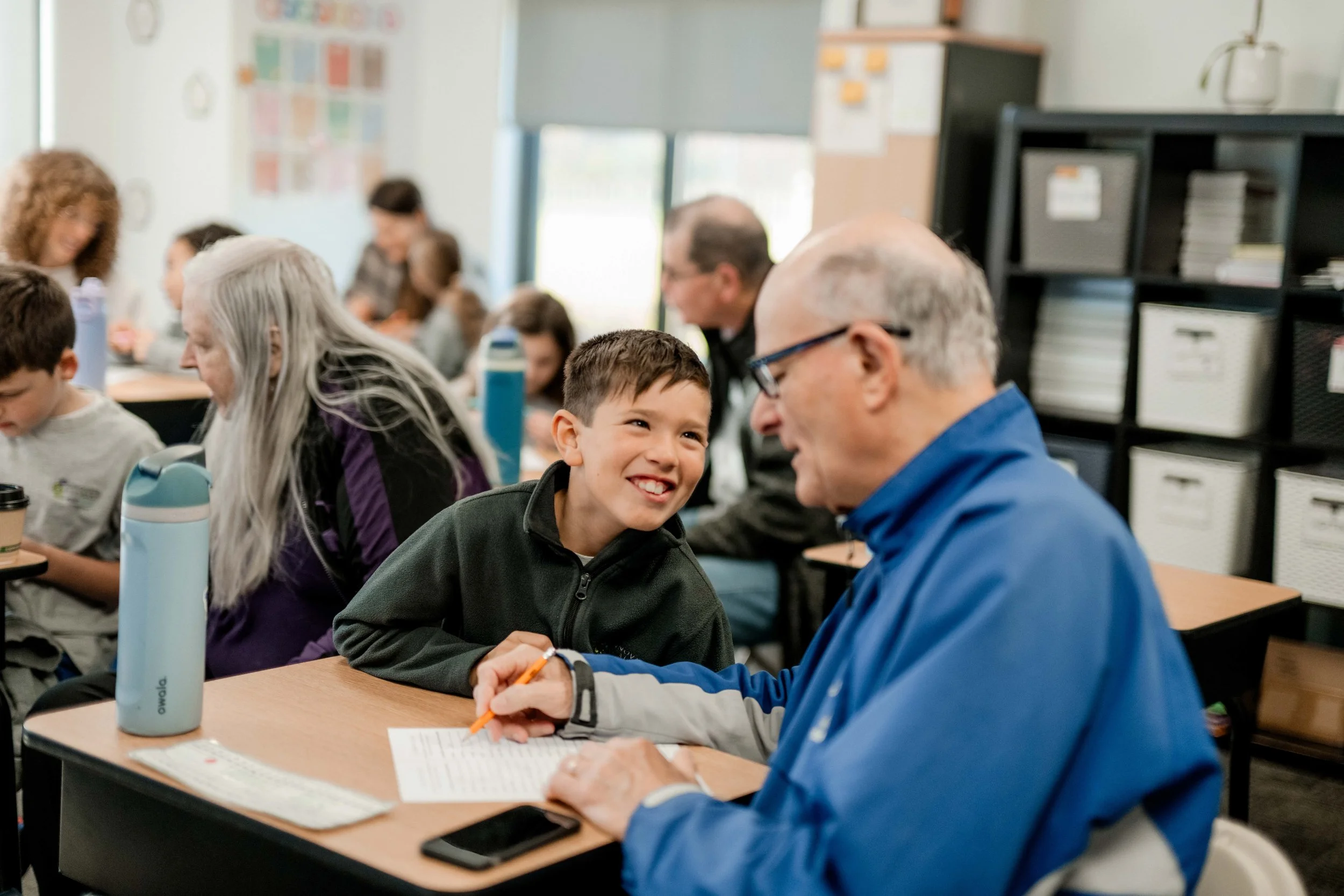
Our recent Grandparents Day celebration offered another expression of this philosophy as scholars created their own Meditations books for their grandparents, reflecting on the virtues, lessons, and wisdom they have inherited from them. Like Marcus Aurelius, they practiced the art of recognizing those who have helped them become who they are.
And the learning moves in both directions. Grandparents offer memory, experience, and perspective; children bring curiosity, imagination, and new questions. The most meaningful intergenerational communities do not simply preserve the past. They invite each generation to participate in shaping the future.
Perhaps the most important question we can ask a child is not simply, "What do you want to become?" but "Who is helping you become that person?"
Every scholar is a culture-maker. But before we can shape the future, we must recognize the people who helped shape us.
