
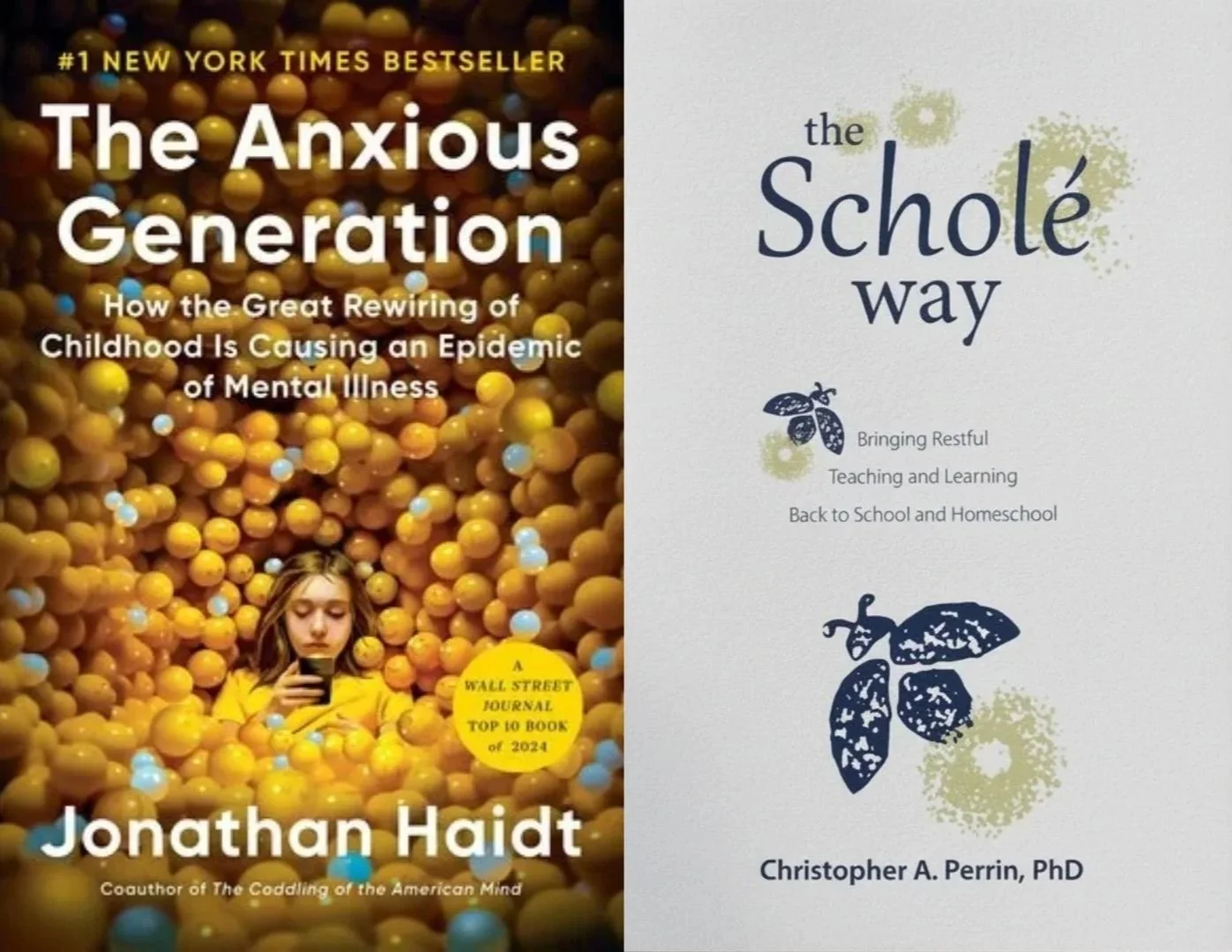
October Book Reviews | Jonathan Haidt's The Anxious Generation and Christopher Perrin's The Scholé Way
What if the problem with modern childhood isn't that children are learning too little, but that they have too little time and freedom to experience the world deeply?
Two books, written from different intellectual traditions, offer complementary perspectives on that question. In The Anxious Generation, social psychologist Jonathan Haidt examines how smartphones, social media, and the decline of independent play may be reshaping childhood. In The Scholé Way, classical educator Christopher Perrin invites readers to recover an older understanding of education—one rooted in contemplation, wonder, and the pleasure of learning.
One book asks what we have lost. The other asks what might be worth recovering.
The Anxious Generation: When Childhood Moves Online
Haidt's central argument is that childhood underwent a dramatic transformation as smartphones and social media became central to adolescent life. He describes a shift away from what he calls a play-based childhood toward one increasingly organized around digital experiences.
Children, he argues, need opportunities to explore, take manageable risks, develop friendships, solve problems independently, and encounter the physical world. Yet these experiences have increasingly competed with screen-based entertainment and online social comparison.
Haidt is particularly concerned about the emotional consequences of this transformation. Social media can make childhood feel like a continuous performance, where appearance, popularity, and achievement are publicly measured and compared.
His argument is provocative, although not without controversy. Researchers continue to debate the strength of the evidence connecting digital technology to rising adolescent anxiety and depression. The causes of children's mental-health difficulties are complex, and smartphones alone cannot explain them.
Nevertheless, Haidt raises an important question for parents: Are we giving children enough opportunities to develop confidence and independence in the real world?
His proposed response includes more independent play, stronger real-world communities, and greater intentionality about when and how children enter digital life.
The Scholé Way: Recovering the Art of Attention
Where Haidt examines the pressures shaping contemporary childhood, Perrin turns to an ancient educational ideal.
In The Scholé Way, Perrin explores the Greek concept of scholé, the root of our word school. Far from describing inactivity, scholé suggests time devoted to meaningful study, contemplation, conversation, and intellectual delight.
Perrin challenges the tendency to equate educational excellence with speed, volume, and constant activity. Genuine learning, he argues, requires opportunities to linger over worthwhile ideas, revisit difficult material, and develop habits of sustained attention.
His vision is closely related to festina lente, the Roman expression meaning "make haste slowly." The goal is not to make education less demanding, but to make its demands more purposeful.
For classical Christian educators, this distinction is essential. A scholar who can quickly produce an answer has demonstrated one kind of skill. A scholar who can explain that answer, defend it, connect it to other subjects, and apply it wisely has developed something more enduring.
Perrin reminds us that education is not simply the transmission of information. It is the formation of a person capable of wisdom, discernment, and wonder.
Where the Two Books Meet
At first glance, Haidt and Perrin seem to be addressing different problems. One examines the psychological and social consequences of digital childhood. The other explores the philosophy and practice of classical education.
But their arguments intersect around a common concern: the disappearance of sustained attention and meaningful experience from children's lives.
Haidt worries that digital environments are displacing the relationships, challenges, and experiences through which children develop. Perrin worries that hurried, overly instrumental approaches to education can displace the contemplation and intellectual delight through which students develop wisdom.
Both invite adults to reconsider the assumption that more stimulation, more activity, and faster progress necessarily produce better outcomes.
Their perspectives also differ in important ways. Haidt is primarily concerned with childhood development and the digital environment. Perrin offers a philosophical and educational ideal grounded in the classical tradition. Neither book, by itself, proves that a particular school model prevents anxiety or guarantees academic success.
Read together, however, they encourage a more thoughtful conversation about what children need.
Perhaps the question is not simply how to help children keep pace with a rapidly changing world. Perhaps it is how to cultivate the attention, judgment, resilience, and relationships that will allow them to flourish within it.
What This Means for Innovate Families
This October, Innovate Academy's study of ancient Israel, Greece, Egypt, and Rome offers a practical illustration of these ideas.
Rather than treating history as a collection of disconnected facts, scholars encounter ancient civilizations through Scripture, literature, science, mathematics, art, and hands-on investigation. Friday learning at home creates opportunities for families to revisit these ideas together, while iLAB encourages scholars to investigate, experiment, and improve their work.
Our Fall Festival brings another dimension to this learning. Through STEM competitions for Pre-K through Grade 2, House challenges, costumes, and creative activities, scholars have opportunities to apply their knowledge in a joyful, collaborative setting.
And through the Culture Maker Committee, parents are helping create the experience itself—modeling the curiosity, service, collaboration, and creativity that we hope to cultivate in our children.
Haidt might recognize the value of children participating in a shared, real-world community. Perrin might appreciate an educational experience in which serious study culminates in wonder and celebration.
Together, their books offer an invitation to families: make room for experiences that cannot be reduced to a screen, a score, or a schedule.
Read together. Ask difficult questions. Build something. Practice a skill. Spend time outdoors. Allow children to experience the satisfaction of understanding something they once found difficult.
And occasionally, resist the temptation to hurry.
Our October reading question: Are we preparing children merely to succeed in the world as it is—or helping them become the kind of people who can make it better?
