
Years ago, Innovate scholars planted some of the first seeds in our community garden. It was a small act—hands in soil, tiny seeds disappearing beneath the surface—but also a fitting picture of how we have come to think about wellness at Innovate Academy.
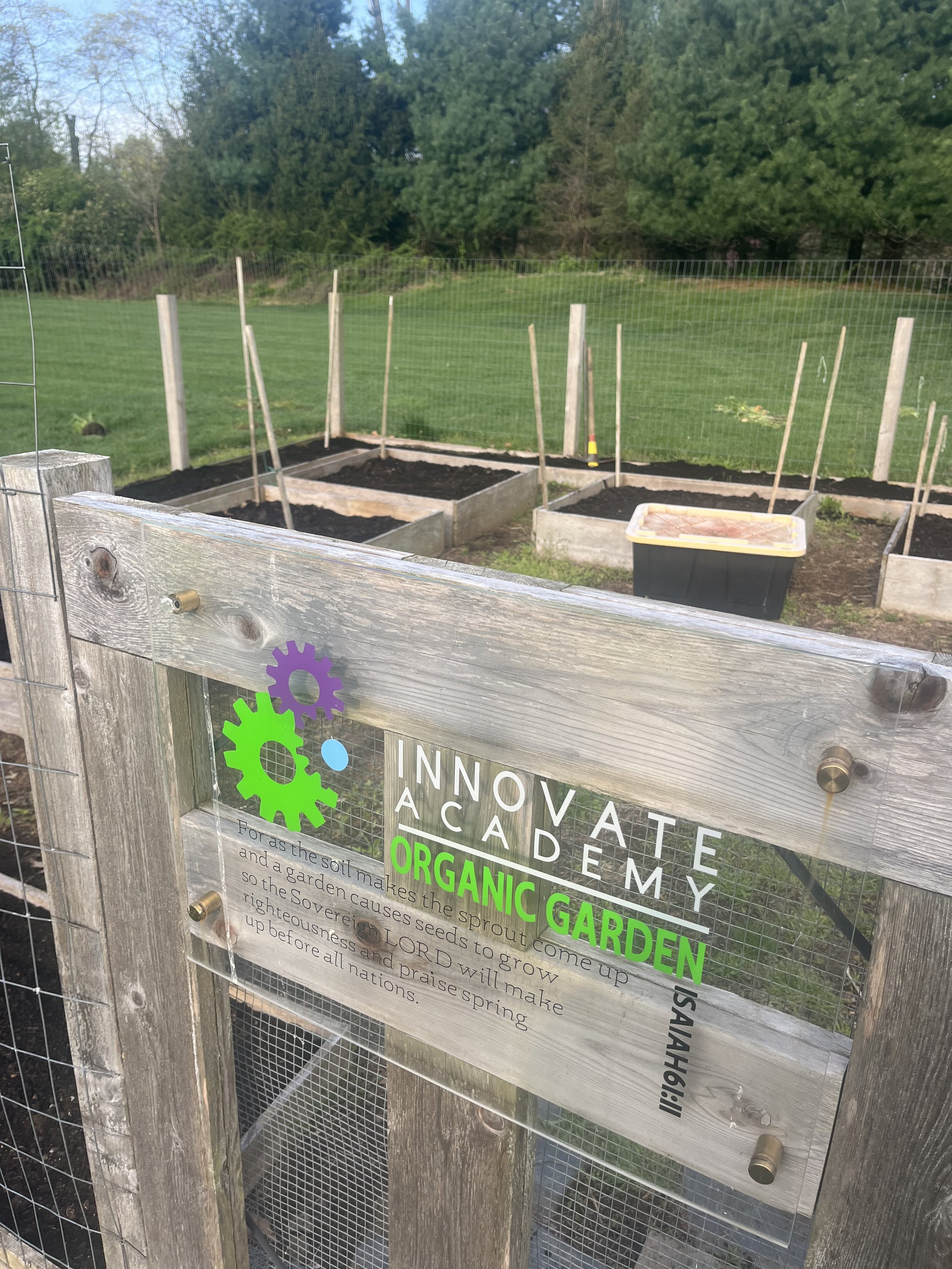
What we cultivate matters.
Wellness at Innovate has never belonged to a single room, program, or definition. It is broader than physical health and broader than mental health. It is part of our commitment to forming the whole person—mind, body, and spirit.
Sometimes that formation happens quite literally in the garden. It also happens through cooking, Herbology, running and fitness clubs; through conversations about biblical friendship and peacemaking; through learning to recognize and regulate emotions; through prayer and spiritual practices; and through the daily work of renewing our minds.
Like anything we hope will flourish, wellness is cultivated through small practices repeated over time.
So we asked four members of the Innovate community what those practices look like in their own lives: Robbie Schmidtberger, Innovate parent and pastor; Jess Hartzell, Innovate parent and school counselor; Kori Orth, Innovate parent, registered nurse, Integrative Health Practitioner, and life coach; and Kerstin Lindquist, longtime Innovate parent, national wellness expert, author, and creator and host of StRest, who recently hosted an episode of Innovate Academy's Raising Culture Makers podcast.
Their answers were strikingly different—and remarkably complementary.
For Robbie, wellness begins with stewardship. For Jess, it begins with renewing the mind. Kori's own health journey taught her to stop separating physical health from mental, emotional, and spiritual well-being. And Kerstin sees wellness through the lens of joy and calling: caring for ourselves so we can be fully present to the life God has given us.
Together, their stories offer four windows into what it might mean to cultivate a life that is truly well.
Robbie: Receiving the Body as a Gift
For Robbie Schmidtberger, wellness begins with something remarkably concrete: God gave us bodies.
“Wellness is an aspect of stewardship,” he says, “specifically taking care of the physical body the Lord has given me through exercise, eating well, rest and work, worship, and service.”
That understanding has shaped his family's rhythms. Robbie's boys join him for runs. They ride bikes together. They pray over meals, acknowledging their food as a gift. And every Sunday, their family intentionally practices Sabbath.
Innovate's weekly rhythm, with at-home learning on Fridays, has helped them preserve Sunday for worship, rest, and enjoying God's good gifts, rather than letting schoolwork spill into it.
Robbie finds the pattern in Christ Himself. Alongside Paul's reminder that our bodies are temples of the Holy Spirit, he returns to the Gospel accounts of Jesus deliberately withdrawing from crowds to pray.
“If Jesus withdrew to be with the Father, how much more should we?” Robbie asks.
His own spiritual practices reflect that rhythm. He prays through the Psalms, journals, practices the examen, and sometimes uses an emotion wheel to put words to what he is experiencing before bringing it to God.
“It helps me to state where I am coming from as I go to the Lord,” he says.
His church community participates in that stewardship, too. Fellow leaders check in with one another about sleep and health. Robbie runs with members of his congregation and meets with a Christian counselor who helps him recognize connections between mind and body.
Years ago, a mentor introduced him to Francis Schaeffer's No Little People, No Little Places, with its insistence upon the importance of quietness and peace before God. Robbie has carried that lesson into his own leadership.
“I seek to personally cultivate rest, quietness, and peace,” he says, “not only to take care of my own body, but to be a non-anxious leader and pastor for God's people.”
Wellness, in other words, isn't merely something Robbie does for himself. It shapes the kind of husband, father, pastor, and neighbor he can become.
Jess: Renewing the Mind
For Innovate parent and school counselor Jess Hartzell, wellness begins somewhere less visible.
The mind.
“Wellness means to me having a renewed mind, focusing on things above, looking for the good in things,” she says.
Her definition extends naturally into the physical—movement, nourishing food, good sleep—and the spiritual through prayer, discernment, and trusting God. But throughout it runs the conviction that how we learn to think affects how we learn to live.
Over the years, Jess has intentionally developed habits that train her attention toward what is good, true, and beautiful.
That doesn't mean ignoring difficult things. Her work as a counselor often requires exactly the opposite. Jess helps scholars work through difficult circumstances, consider new perspectives, develop healthy relationships, and find practical strategies for coping with stress.
“I try to practice what I preach,” she says, “by using the strategies I teach others and applying them to my own situations.”
Motherhood sharpened that conviction. Jess realized that caring well for her family also required her to be more intentional about her own sleep, exercise, mental health, and spiritual life.
At home, she tries to make those practices visible.
“I try to model mental, physical, and spiritual wellness through my thoughts, words, actions, and physical activity,” she says, “and I teach my children to do the same.”
Last year, Jess brought that philosophy into a study-skills class with Upper School scholars. Alongside organization and academic strategies, scholars explored mindset, stress management, relationships, and what Scripture teaches about how we think, treat others, and care for ourselves.
Rather than prescribing a single formula, Jess helped them begin assembling their own toolkit of healthy strategies.
Her touchstone is Christ's invitation in Matthew 11:28–29: “Come to me, all you who are weary and burdened, and I will give you rest.”
Wellness doesn't mean that our children will never experience worry, disappointment, stress, or weariness.
Part of forming them well is teaching them what to do—and where to go—when they do.
Kori: Putting the Whole Person Back Together
Kori Orth's understanding of wellness was transformed by an experience from the other side of healthcare.
Years of training and work as a registered nurse had shaped how she thought about health. But when Kori began experiencing health challenges of her own, the questions she encountered led her to reconsider whether the absence of troubling symptoms was a sufficient definition of being well.
Her search eventually became vocational.
Today, Kori works as an Integrative Health Practitioner and life coach, helping clients consider the many factors that may contribute to how they feel and live. Her own experience also convinced her that physical, emotional, mental, and spiritual wellness cannot be neatly separated from one another.
“I'd been treating my physical body as if it were separate from my mind and spirit,” Kori says. “Once I saw that connection, I couldn't unsee it. It changed how I understood wellness completely.”
Her definition now begins with Jesus' words in John 10:10 and the promise of abundant life.
For Kori, that means having the energy and stamina to do the work God has given us and to be fully present within our families and communities. It also means learning to live from peace rather than fear and letting our identity in Christ—not circumstances or false beliefs—define us.
That philosophy has changed the Orth household in wonderfully ordinary ways.
The family pays attention to sleep, movement, the products and water they use, and the foods they eat. One practice has become especially tangible: they mill their own flour and bake with it at home.
Kori has even brought that practice to Innovate, teaching scholars in Cooking Club about fresh-milled flour and demonstrating the process firsthand. She has also shared her experience with Innovate mentors and staff through an in-service on health and mindset.
But the practices in her home aren't only physical.
Kori also helps her children understand the relationship between thoughts, feelings, and behaviors and teaches them how to work through emotions rather than simply react to them.
That is where her own journey ultimately led her: away from thinking about wellness as fixing one isolated part of a person and toward seeing the person as a whole.
“I didn't know what I didn't know,” she says.
It is one reason Hosea 4:6—“My people are destroyed from lack of knowledge”—has become meaningful to her. For Kori, learning has become part of stewardship: asking questions, examining habits, and then sharing what she discovers with others.
That desire to equip families is now extending into a new project. Kori has been developing Confident Care of the Sick Kid, a course designed to help parents better understand common signs of illness, learn basic assessment skills, recognize when professional medical evaluation may be appropriate, and feel more confident communicating with healthcare providers. She hopes there may eventually be an opportunity to share some of that work with the broader Innovate community.
For Kori, wellness has become not simply something to pursue, but something to teach.
Kerstin: Wellness for the Life You're Called to Live
Kerstin Lindquist has spent more than a decade talking publicly about wellness. After years in live television and helping build QVC's wellness department, she created StRest, her wellness brand and podcast that brings together health science, practical habits, and biblical truth. She is also an author, speaker, national wellness correspondent, and recently brought her experience behind the microphone as host of an episode of Innovate Academy's Raising Culture Makers podcast.
And yet when asked to define wellness, Kerstin doesn't begin with any of the measurements the modern wellness industry has taught us to watch.
“For me, wellness isn't just about the number on a scale or how many steps I log in a day,” she says. “It's joy and calling.”
Her question is different: Am I able to access the joy of the Lord, hear from Him, and obey what He is calling me to do in this season?
Sleep matters. Movement matters. Nutrition matters. Relationships matter. Spiritual health matters.
They matter because they all affect our capacity to be present for the life we have been given.
“Soul work comes before body work,” Kerstin says, “but you can't be truly well without having them both.”
She learned that lesson during seasons when wellness was anything but easy.
Years of infertility, addiction within her family, and her mother's diagnosis with dementia at only 59 confronted Kerstin with the limits of sheer willpower. Her babies were not yet a year old when her mother was diagnosed, and Kerstin would spend the next eleven years in what she describes poignantly as “walking her home.”
“I couldn't white-knuckle my way through hard seasons on willpower alone,” she says. “I needed to actually rest, actually feel, actually pray, and actually take care of my body while I waited for answers I didn't have.”
Then comes one of the most compelling lines in her philosophy: “Wellness isn't a reward for when life is easy; it's the thing that gets you through when it isn't.”
Her mother's illness eventually led Kerstin back to school to study health coaching, health science, neuroscience, and stress. Her journey also forced her to confront fear and ask whether the life that looked safest was necessarily the life God was calling her family to live.
At one point, Kerstin and her husband took their children out of school, stepped away from work for four months, and moved to Mexico to serve as missionaries. Later came another leap: leaving a successful corporate career to follow the direction she believed God was taking her professionally.
Her children have watched both the work and the uncertainty.
“They see me rest, and they see me pray,” she says. “They see me hustle God's way for the things He is calling me to, not the world.”
Which raises perhaps the most important question in the modern wellness conversation: What are we getting well for?
For Kerstin, energy, strength, and mental clarity aren't ends in themselves. We care for ourselves so that we can be available—to God, to our families, to our neighbors, and to the work we have been given.
Her goal through StRest, her media work, speaking, and writing is “to talk about health in a way that's rooted in truth, not fear, and to help people see that taking care of themselves and drawing closer to God aren't separate projects.”
And despite the national reach of her work, its purpose remains remarkably close to home.
“My son Ben's world and my work don't live in separate lanes,” she says. “A big part of why I do what I do is so I can be ever present for my kids.”
What Are We Cultivating?
Four people. Four vocations. Four different paths into the same conversation.
Robbie reminds us that our bodies are gifts to steward and that rest is part of faithful work.
Jess reminds us that our minds must be continually renewed, and that resilience can be taught and practiced.
Kori reminds us that wellness requires seeing the whole person, rather than treating our physical, emotional, mental, and spiritual lives as unrelated pieces.
And Kerstin reminds us to ask what our wellness is for—because health is ultimately valuable not merely for what it allows us to avoid, but for what it enables us to give.
Perhaps that is why wellness belongs so naturally within a classical Christian understanding of education.
At Innovate, we talk about forming the whole scholar—head, heart, and hands. We want children who can think deeply, certainly, but also children who know how to work and how to rest; how to recognize what they are feeling and bring it before God; how to nourish and move the bodies they have been given; how to form healthy friendships; how to encounter difficulty without being ruled by fear; and how to cultivate habits that make them increasingly available to God's purposes.
And that brings us back to those seeds in the Innovate garden.
A garden does not flourish because someone tells it to.
It requires good soil. Water. Light. Pruning. Protection. Rest. Attention. And, perhaps most importantly, time.
So do people.
A Sabbath kept. A meal shared. A run with Dad. Bread made from freshly milled grain. A thought redirected. A phone left untouched for the first few minutes of morning. A Psalm prayed. A difficult emotion named. A body given sleep. A burden brought to Christ.
These practices can seem remarkably small, but formation almost always is.
We become what we cultivate.
And perhaps Christian wellness begins by tending, faithfully and patiently, the life God has already planted in us.
